Listicle
5 Reasons Your Thumb Gives Out Twenty Minutes Into Playing (And Why It Isn’t The Arthritis You Were Told It Was)

In fifteen years of treating hands, I have watched hundreds of guitarists put the instrument down for the same reason. It is almost never the reason they were given — and once you see what is actually happening at the base of your thumb, the twenty-minute limit stops being a mystery.

1. The motion isn’t wrong. The load is.
Let me take one thing off your shoulders first, because nearly every player who sits down in front of me has already decided the problem is their technique.
It isn’t. Every time you press a string, your thumb is the anchor behind the neck. It braces, it pinches, and it absorbs the counter-force of every chord you have ever played. One hour of practice runs that load through one small joint somewhere between eight hundred and two thousand times.
That is not bad form. That is what the instrument asks of a hand.
What matters is how much of that load the joint has already taken, and how much it has left to give. You have been making the same movement since you were a teenager. The joint has not been keeping score, but it has been keeping count.
So the ache is not a sign that your playing has slipped. It is a sign that the joint has started moving in a way it was never built to move.
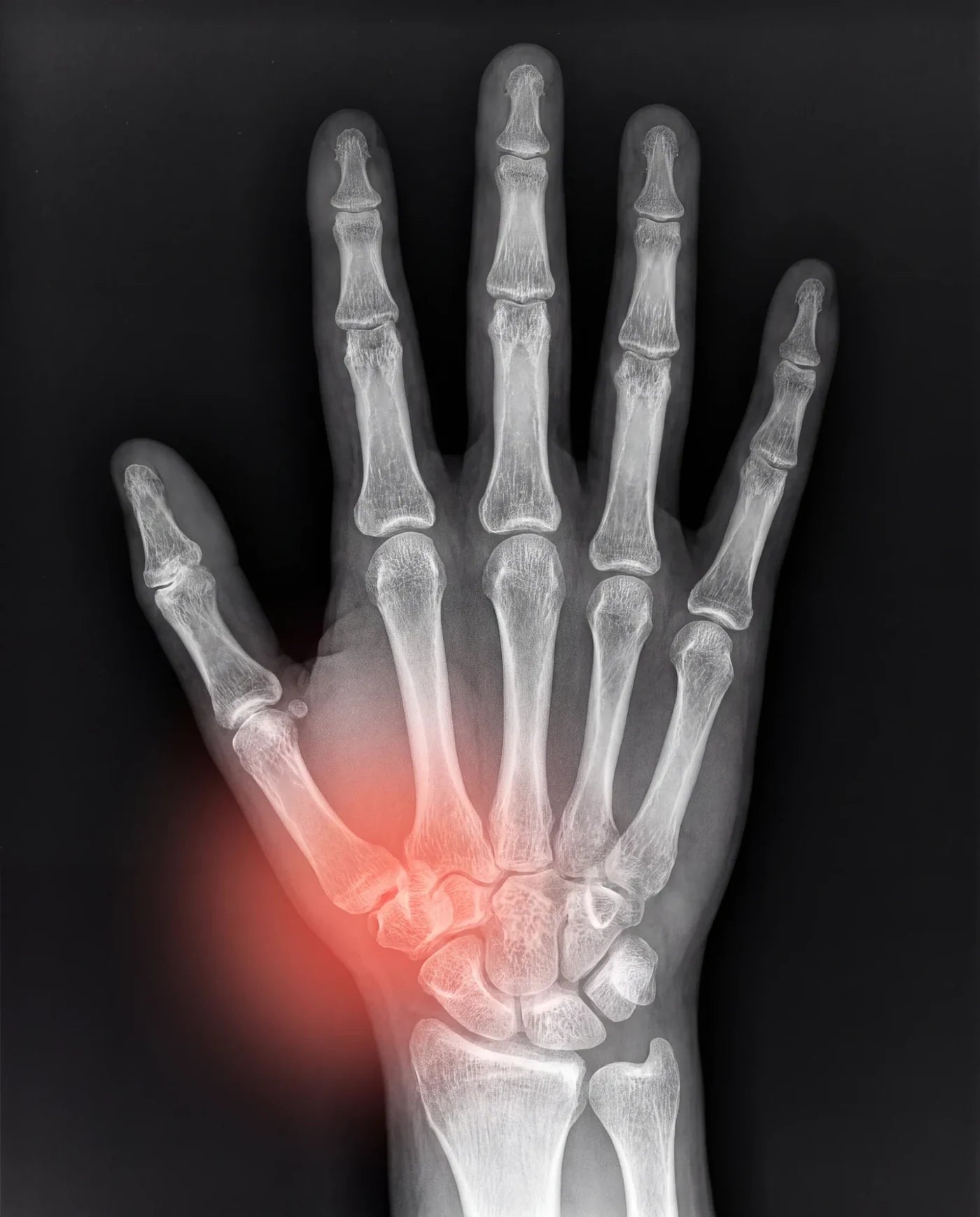
2. What I actually find is a joint that has come loose
Here is what gets missed, and it gets missed because on a scan it looks like wear.
Where your thumb meets your wrist sits the CMC joint — the carpometacarpal. It is built like a saddle rather than a hinge, and that shape is the only reason your thumb can reach across the fretboard, pass under your fingers and stretch for a chord your hand has no business reaching. It is also the least stable connection anywhere in your hand. No bone locks it in place. A small band of ligaments is doing that job alone.
Squeeze under load for enough years and those ligaments stretch, the way a leather strap stretches. They do not snap back. And once they have given, the joint stops sitting cleanly in its socket and starts sliding across itself every time you reach.
Not a few times a session. Closer to a thousand.
That sliding is the whole story. Arthritis, tendonitis, wear and tear — those words describe what the sliding has already done to the cartilage. They do not describe what is doing it. And the distinction is not academic: a worn joint and a loose joint call for opposite treatments. Everything you have been offered was built for the worn one.
Which is exactly why none of it held.

3. A loose joint does not tighten on its own
This is the part I wish more players heard early.
Ligaments are not muscle. They carry almost no blood supply of their own, which is why they heal slowly when they heal at all, and why a stretched one generally stays stretched. Meanwhile the small stabilising muscles around the thumb — the ones that might have compensated — weaken every month you play less.
So the joint gets looser and the support around it gets thinner, at the same time.
You already know what that looks like from the inside. The hour you used to get became forty minutes. Forty became twenty. Now the ache arrives before the second song, and you have started choosing material around it — nothing heavy on barre chords, nothing that lives in F, nothing that asks the thumb to hold a stretch.
That is not you getting older. That is a measurable structure getting measurably looser, and every week without something holding it is a week it gives a little more.

4. Everything you’ve been offered treats the swelling, not the slide
Look at what you have already tried, and notice they all share one blind spot.
Rest. Two weeks off and the pain quietens. You pick the guitar back up and it is back inside one session. Rest never touched the loose joint — it only let the inflammation around it settle. The instability was waiting exactly where you left it.
“Just stop playing.” Usually said by someone with no idea what they are actually asking you to hand over. And it does not even work on its own terms: the joint stays loose whether you play or not.
Cortisone. The first injection buys a few months. The second buys less. The third tends to arrive with a surgical referral attached. Cortisone quiets an inflamed joint; it does nothing to steady a sliding one. A fair number of players also tell me it dulls their touch and tone for weeks afterwards.
Rigid splints. These do address stability — by removing motion altogether. Fine for a fracture. Useless for a hand that has to fret. One of my patients called it playing in a boxing glove, and he was being generous.
Compression gloves. They apply the same pressure everywhere, which means the one joint that needs holding gets no more support than the eight that don’t — while the fingertips you play by feel with end up covered.
Five treatments, one blind spot. Every one of them is aimed at the swelling, the pain, or the whole hand. Not one of them holds the joint that is actually moving.
5. And every rest-and-return cycle starts from further back
Here is the pattern I have watched run more times than I can count.
The thumb aches, so you rest it. It settles, you come back, and it flares sooner than last time. So you rest longer. Not two weeks now — a month, then a season. The guitar moves from the stand to the case. The case moves from the living room to the spare room.
And in all that time off, the muscles keep thinning while the joint stays exactly as loose as it was. So every comeback begins from further back than the last one.
Almost nobody decides to stop playing. That is the cruel part of it. There is no last session that anyone recognises as the last session. You simply play a little less each month, until one day you work out you have barely picked it up in a year — and the thing you have done since you were fifteen, the thing you would have called part of who you are, has quietly gone without either of you saying anything about it.
Nothing in that pattern breaks until something holds the joint.
So What Can You Actually Do About It?
For a long time players were handed two doors.
Door A. Stop playing.
Door B. Keep playing and pay for it.
Both are unacceptable to anyone who actually plays. And both exist only because everyone kept treating the wrong thing.
Follow the mechanism and a third door opens on its own. If the problem is that one joint slides under load, then the answer is not to quiet the swelling afterwards, and not to immobilise the hand beforehand. The answer is to hold that one joint steady while the load is going through it.
Which sets four requirements, and none of them are negotiable:
✓ It has to stabilise the CMC joint under load — while you are fretting, not while you are sitting still with your hand in your lap
✓ It has to hold that joint without locking the thumb or the wrist, or you have simply bought a rigid splint in softer fabric
✓ It has to leave every fingertip and the thumb pad uncovered, because the moment a brace covers the pads you are playing through a layer
✓ It has to be slim enough to sit behind the neck, under a stage sleeve or at a piano without catching on anything
Read those four again and notice what they rule out. A rigid splint fails the second. A compression glove fails the first and the third. Rest fails all four. That is not a list written to flatter a product — it is what the mechanism demands, and it happens to explain why nothing on the shelf has worked for you.
So after fifteen years of watching players leave my clinic wearing braces that solved the wrong problem, I worked with a small team of designers to build the one thing that meets all four.

The first brace built around the way a player’s thumb actually moves
The Thumb Stabilizer is a slim, contoured support shaped around the exact motion your thumb makes under load. Four parts, matching the four requirements:
- A contoured pad that sits over the CMC joint and holds it in alignment every time you squeeze the neck, reach across the board or stretch for a chord. It works with the motion rather than against it, which is how it can hold the joint without locking the hand.
- Soft, breathable fabric. No metal stays, no rigid plastic. Nothing to scrape the back of the neck, nothing to catch on a sleeve, nothing that makes a sound when your hand shifts position.
- Every fingertip and the thumb pad left bare. You feel the strings exactly as you did before. That is the whole point — a support you can forget you are wearing is the only kind you will actually keep on while you play.
- A left and a right in every order, so whichever hand is loading the joint, you are covered.
Now the honest part, because you have been sold things before.
It is not a medical splint and it is not a cure. It will not reverse arthritis, it will not put stretched ligaments back the way they were, and anyone telling you a piece of fabric can do that is selling you something.
What it does is narrower than that, and more useful. It holds the sliding joint steady so the motion stops grinding it. For most players that is the difference between five minutes and a full song — not because anything healed, but because the thing causing the pain stopped happening while they played.
Check Availability
Over 20,000 players are using it to keep playing
It started with fretting hands — guitarists and bassists — because that is where the sliding joint shows up earliest and hardest.
But it is the same joint, loaded slightly differently, that pinches when a pianist reaches for an octave, or when anyone grips something small for hours at a time. So it has travelled well past the fretboard, mostly to people who had quietly stopped doing the thing they loved and did not much want to explain why.
A note on availability.
There is a sale running at the moment. The last restock went in eleven days, so if this is something you have been meaning to try, it is worth a look while it is there.
Two things go wrong in that joint at the same time. Your order covers both.
One holds the joint · One keeps it held
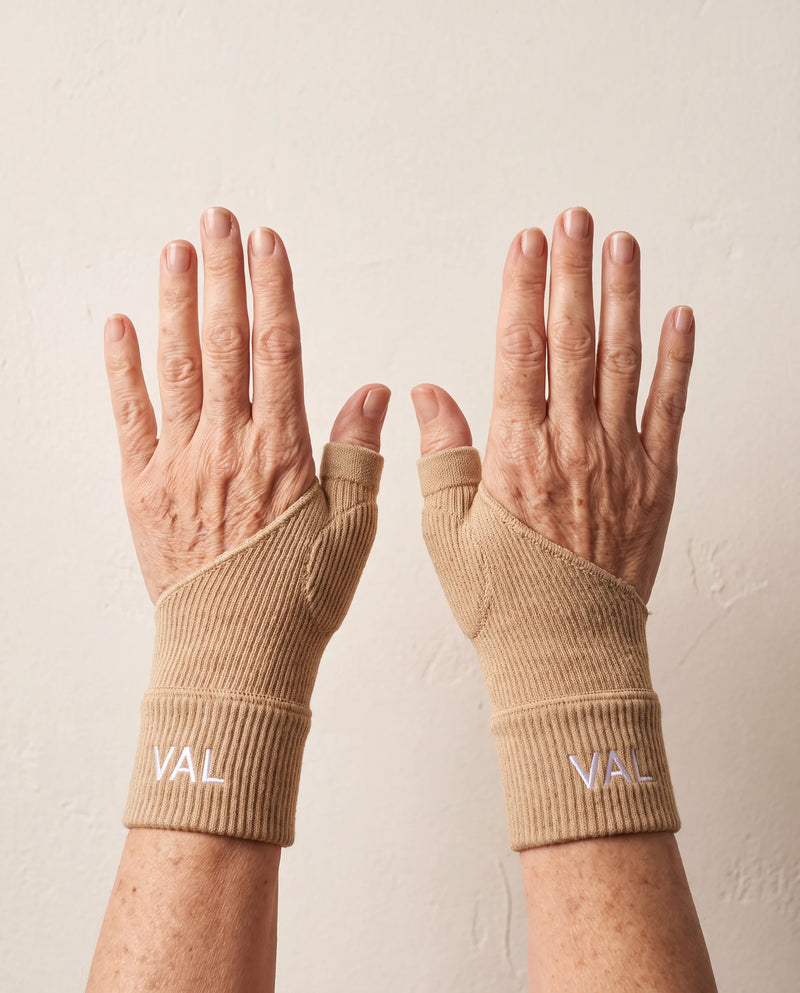
The Thumb Stabilizer Holds the sliding joint while you play. A left and a right in every order, so it goes on whichever hand is doing the work.
The path to a healthier joint and a plan for improvement.
The Path To A Healthier Joint Three minutes of what I give my own patients before they play, put together with several hand specialists. The brace holds the joint. This keeps the muscles that hold it from thinning.
Both, with thirty days to test them on your own hands rather than take my word for it.
Wear it through ten rehearsals. If you are not playing longer with less ache, send it back — and I would rather you did. A brace sitting in a drawer helps nobody.
Which leaves one question worth answering.
You already know what the next twelve months look like if nothing changes, because you have just watched the last twelve. The window gets shorter. The material gets easier. The case stays shut a little longer each time.
The other way costs less than a set of strings and a decent capo, and you have thirty days to find out which one it turns out to be.
Check AvailabilityI have left the link above.
If your hands are anything like the ones I see every week, it is worth a look.
— Dr. Hale
Thanks — your comment has been submitted and will appear once it has been reviewed.
Has anyone here actually got on with one of these? Every brace I’ve tried just ends up getting in the way.
I play in a covers band on weekends. My fretting thumb gave out after twenty minutes. This is the first support that lets me barre a chord. Not rigid, not bulky, and the joint stays put.
My orthopedist gave me six minutes and told me to find a different hobby. He never asked how I hold my needles. I wear this every evening now and I have not canceled one.
I rested it for three weeks. Then I picked up my needles and lasted nine minutes. This is the first thing that held while I was knitting, not after. I finished the cardigan that sat in the basket since November.
My hand used to give out halfway through anything with octaves. Last week I played the whole piece without shaking my hand out once. My piano group noticed before I said a word.
Does it say anywhere whether this is for the left or the right hand? I only need it for my fretting hand.
It comes as a pair, one for each hand, I found it in the product details. I only needed my left one too.
My daughter bought me a compression glove last Christmas and I never told her it did not help. This one does. I picked my granddaughter up off the floor last week without thinking about my hand first.
I used to shake my hand out between every hole by the back nine. Last Tuesday I played all eighteen holes and did not set my club down once.
Genuine question, is this actually any different from the cheap ones on Amazon?? I’ve bought three or four over the years and every one either locks my thumb solid or the stitching goes within a fortnight.
I play three matches most Saturdays in the summer heat, and I sweat through everything. This stayed put through all three and my hand felt normal walking to the car.
I garden four days a week and my thumb was done by lunch. This fits under my glove. Nobody notices it and I have not had to stop early since.
I had a padded steering wheel cover and driving gloves before this, and neither one stopped the click when I turned into a spot. This did, the first week I wore it. I parallel parked in one try last Tuesday.
I wrung out a dishcloth without stopping for the first time in two years. My husband noticed before I said anything.
Anyone know how long shipping takes? I play bass in a covers band and thinking of grabbing a few, half of us are falling apart.
Mine came in about a week. The thumb’s completely open on it so it doesn’t get in the way.